

Cold storage vs Dry warehouse India: Why Cold Storage Is the Smartest Investment in India Right Now — and for the Next 20 Years
India’s Warehousing Gold Rush Is Cold — Here’s Why Smart Investors Are Choosing Chill Over Dry
9 min read · Investment Guide · Cold Chain vs Dry Warehouse
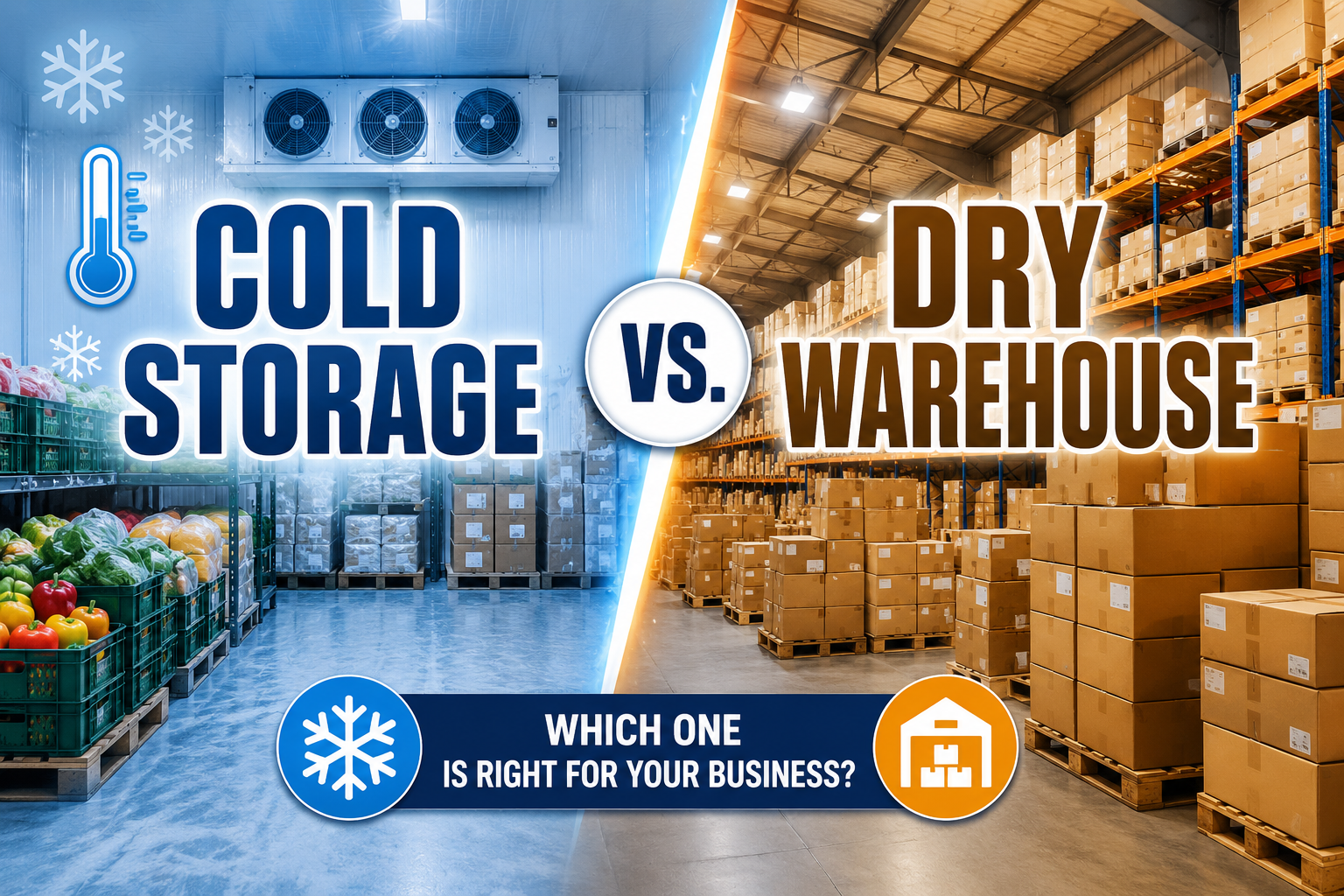
Cold Storage vs. Dry Warehouse: Why Cold Storage Is India’s Smartest Infrastructure Investment — Right Now and for the Next 20 Years
If you own land. If you have capital. If you are standing at the decision point of what to build — read this before a single slab of concrete is poured.
Because the data in 2026 points in one clear direction — a direction that most people in warehouse and logistics real estate are either missing or choosing to ignore. Cold storage is not simply a better option than a dry warehouse. It is categorically, measurably, and structurally superior as a long-term business investment. For this decade. For the next. And for the twenty years beyond that.
This is not a sales pitch. It is a data comparison. And by the time you reach the end, you will know exactly why.
The Numbers That Define Two Very Different Futures
When you build a warehouse or cold storage facility, you are not building for today. You are building for 15 to 20 years of occupancy, income, and asset appreciation. So let’s start with the most important comparison of all — market growth rate.
| Cold Storage | Dry Warehouse | |
| CAGR (2026 onwards) | 25% | 8.36% |
| Market Size Projection | $74.5 Billion by 2033 | $59 Billion by 2030 |
The cold storage market is growing at three times the speed of the dry warehouse market — from a base that is still severely undersupplied, and with active government funding pushing it forward.
The dry warehouse market, by contrast, is growing into a space already dominated by IndoSpace, Blackstone, DHL, ESR, and every major global logistics real estate firm. In Bhiwandi, Sriperumbudur, Luhari, and every major logistics corridor across India, Grade-A dry warehouse supply is being added at a pace that is compressing yields and raising vacancy risk.
The Core Case in One Paragraph
Cold storage grows 3x faster, earns rental rates 2 to 4 times higher per square foot, attracts clients on 5 to 10 year lock-in contracts, benefits from government subsidies that reduce your capital cost by 35 to 50 percent, and is protected by a 35 million metric tonne capacity shortfall that will not be filled for at least a decade. That is the investment case.
Rental Rates: Cold Storage Earns 3–5x More Per Square Foot
The single most important number in any warehouse investment is the rental rate you can command.
Dry Warehouse Rental Rates in India (2026)
- Delhi NCR (Grade-A): ₹25–₹35 er sq ft per month
- Mumbai / Bhiwandi: ₹28–₹40 per sq ft per month
- Bangalore: ₹22–₹40 per sq ft per month
- Tier-2 cities: ₹15–₹27 per sq ft per month
Cold Storage Rental Rates in India (2026)
- Pharma-grade cold rooms (GDP compliant): ₹150–₹250+ per sq ft per month
- Multi-commodity cold storage: ₹80–₹150 per sq ft per month
- Export-grade cold rooms (IQF, blast freeze): ₹100–₹200 per sq ft per month
- Urban micro cold hubs (quick commerce): ₹120–₹250 per sq ft per month
What this means in practice: A 10,000 sq ft cold room earns ₹8–18 lakhs per month. The same 10,000 sq ft as a dry warehouse earns ₹2–4 lakhs per month in the same city. That gap is structural — cold storage rents have a functional floor that dry warehouse rents simply do not.
The Moat: Why Cold Storage Has a Competitive Advantage Dry Warehouses Will Never Match
In business, a moat is what protects your revenue from competition. Dry warehouses have almost no moat. Anyone with land, a PEB contractor, and capital can build one — and they are. The result is exactly what we see today: massive supply addition in major logistics corridors, compressing yields, rising vacancies, and operators forced to compete on price alone.
Cold storage, by contrast, has a deep, multi-layered moat that grows stronger over time.
Regulatory Compliance: Pharma cold rooms require GDP certification, CDSCO compliance, and Schedule M adherence.
Food export cold storage requires FSSAI Central Licensing, APEDA registration, and often EU or international food safety certification. These are not one-time paperwork exercises. They are ongoing operational standards that clients verify before signing contracts — and the compliance cost of switching facilities is simply too high for established clients to consider.
Technical Complexity: Cold storage demands refrigeration engineering, insulation design, controlled atmosphere management, IoT monitoring integration, backup power systems, and deep operational knowledge of temperature management across product types. A competitor cannot replicate your facility in six months. The knowledge barrier and engineering lead time create a genuine first-mover advantage.
Client Tenure: Pharmaceutical companies sign 5-to-10-year lease agreements because switching mid-term means re-validating storage conditions with their regulatory authority.
FMCG and frozen food brands stay because operational continuity is critical to their supply chains. The average cold storage client stays 3 to 5 times longer than the average dry warehouse tenant.
Location Scarcity: Good cold storage land — near ports, pharma clusters, agri corridors, with reliable power infrastructure — is genuinely scarce. Once you build on it, your position is defensible.
The bottom line on client stickiness: A pharma company running GDP-compliant operations from your cold room is not leaving for 7 to 10 years. A 3PL leasing your dry warehouse is gone in 3 years when someone builds a newer, larger shed 5 kilometres away. That difference changes the entire financial model.
The Subsidy Advantage: Cold Storage Gets Up to ₹10 Crore in Government Grants
This is the starkest difference in the investment case — and the one that changes your ROI calculation most dramatically.
What cold storage investors receive:
- PMKSY-ICCVAI Scheme: 35% grant on eligible project cost in general areas; 50% in difficult/hilly areas. Maximum grant: ₹10 crore per project.
- NHB Capital Investment Subsidy: 35–50% credit-linked back-ended subsidy for cold storage capacities between 5,000 and 20,000 MT.
- Agriculture Infrastructure Fund (AIF): 3% interest subvention on loans; collateral-free up to ₹2 crore.
- NABARD Cold Chain Finance: Dedicated lending window with concessional interest rates and repayment terms up to 12 years.
- FIDF: ₹75,000 crore corpus specifically for cold storage linked to marine and seafood exports.
- State-level top-ups: Punjab, Haryana, Andhra Pradesh, Telangana, and Maharashtra add additional incentives on top of central schemes.
What dry warehouse investors receive: No dedicated grant scheme. No subsidy. No interest subvention. Full capital cost. Full loan burden.
The maths: An ₹8 crore cold storage project with a 35% PMKSY grant costs you ₹5.2 crore net. At 50% subsidy, it costs ₹4 crore. Add AIF interest savings of 3% annually, and your effective capex is dramatically lower — shrinking your payback period from 7 years to 4 to 5 years.
The 20-Year View: Cold Storage Gets Stronger Every Year. Dry Warehouses Face Disruption.
Building a warehouse is a 20-year decision. The question is not just which asset earns more today — it is which asset grows more valuable, generates more income, and retains more strategic importance over two decades.
| Timeline | ❄️ Cold Storage | 📦 Dry Warehouse |
| Year 1–2 | Setup and commissioning. First customers in pharma, agri, and FMCG. 50–60% utilisation. | Setup. First 3PL and e-commerce clients. 40–60% utilisation. High agent commissions. |
| Year 3–5 | Stabilisation. 75–85% utilisation. Long-term contracts active. ROI 18–30%. | Break-even zone. Client churn as 3-year leases expire. Rentals under competitive pressure. |
| Year 6–10 | Full maturity. Brand established. Pharma GDP compliance = near-zero churn. Tech upgrades command premium rental. | Automation pressure begins. E-commerce shifting to dark stores. Grade-B assets struggling. |
| Year 10–15 | Regulatory moat deepens. Captive clientele. REIT-grade valuation potential. | E-commerce robotics shift underway. Large-format dry warehouses face structural demand change. |
| Year 15–20 | India’s cold chain at $74.5B+. First movers own the established client base, land, and regional brand. Irreplaceable infrastructure. | Oversupply risk. Automation replaces labour advantage. Commoditised rental market. |
The Disruption Risk in Dry Warehouses Face
Three forces are reshaping the dry warehouse sector that most investors are not factoring into their 15-year projections:
Dark stores : They are replacing large-format distribution hubs as quick commerce platforms scale micro-fulfilment across urban India. The large dry warehouse serving an e-commerce hub becomes progressively less relevant.
Automation — robotic picking, AS/RS systems, AI-driven logistics — is making labour-intensive warehouses obsolete. Un-automated dry facilities will lose clients to automated competitors within the decade.
Oversupply — IndoSpace committed $1 billion+ to new Grade-A facilities. Blackstone committed $5.5 billion to Maharashtra logistics. Welspun One launched India’s largest single-location warehouse at 4.45 million sq ft in JNPA SEZ. Supply is being added at a pace that will compress yields in the best corridors within 5 years.
Cold storage faces none of these risks. Quick commerce dark stores need cold rooms inside them. IoT and smart refrigeration make cold storage facilities more efficient and valuable over time, not less relevant. And India’s 35 million metric tonne structural cold storage shortfall will not be filled for a decade, regardless of how quickly investment accelerates.
Head-to-Head: Every Parameter That Matters
| Parameter | ❄️ Cold Storage | 📦 Dry Warehouse | Winner |
| Market CAGR | 25% → $74.5B by 2033 | 8.36% → $59B by 2030 | ❄️ |
| Government Subsidy | Up to ₹10 Cr grant | 35–50% project cost | No dedicated scheme | ❄️ |
| Rental Rate | ₹80–₹200+ per sq ft/month | ₹16–₹50 per sq ft/month | ❄️ |
| Competition Level | Severely undersupplied — 35 MT shortfall | Oversupplied in major corridors | ❄️ |
| Average Client Tenure | 5–10 years | 3–5 years | ❄️ |
| Vacancy Risk | Low — sector-wide 75%+ utilisation | Rising — Grade-A supply glut | ❄️ |
| Post-Stabilisation ROI | 18–30% | 8–14% | ❄️ |
| Operating Margin | 15–25% | 6–12% | ❄️ |
| Barrier to Entry | High — technical, regulatory, capital-intensive | Low — replicable PEB structure | ❄️ |
| Policy Tailwind | PMKSY + NHB + AIF + FIDF + Sagarmala + Trade Deal | PM Gati Shakti (shared with all sectors) | ❄️ |
| Future-Proof to 2045 | Essential across pharma, agri, and quick commerce | E-commerce automation risk | ❄️ |
| Long-Term Asset Value | Upgradeable refrigeration — building retains value | Depreciates without automation investment | ❄️ |
| Subsidy ROI Acceleration | Effective capex drops 35–50% → payback in 4–5 years | Full capex, full payback timeline | ❄️ |
Cold storage wins all 13 parameters. These are sourced, verifiable, current market data points — not marketing claims.
Addressing the Three Common Objections
“Cold storage costs more to build.” True — construction costs are approximately 2 to 3 times higher per square foot than a dry warehouse. But the government returns 35 to 50% of that cost as a grant. Rental income is 3 to 5 times higher per square foot. Operating margins are 15–25% vs. 6–12%. Payback with subsidy is 4 to 5 years — faster than the 6 to 8 years for a dry warehouse. The higher upfront cost is real. The superior economics are more real.
“Cold storage is harder to operate.” Also true. It requires refrigeration engineers, IoT monitoring, backup power, regulatory compliance, and ongoing quality management. But this operational complexity is precisely your moat — it is why competitors cannot easily replicate what you build. With an experienced technology and engineering partner managing AI-driven monitoring, remote management, and predictive maintenance, the complexity is handled by systems rather than manual intervention.
“What if clients don’t materialise?” India already has a 35 million metric tonne structural shortfall in cold storage capacity. The cold chain market is growing at 25% CAGR. The 2026 India-US trade deal has made pharma, agri, and seafood export cold chain a regulatory requirement. New ports at Vizhinjam and Tuticorin need cold chain infrastructure around them. Quick commerce platforms need cold rooms in every dark store. Schedule M compliance for pharma is now mandatory.
The clients are not coming at some future date. They are already present, actively looking for facilities that do not yet exist. That is the gap you fill.
What to Build, Where to Build It, and What It Costs
₹1–5 Crore: Multi-Commodity Cold Hub A 500–2,000 MT facility near an agri corridor or urban consumption centre. Effective cost after subsidy: ₹65 lakh to ₹3.25 crore. Target clients: FMCG, agri traders, quick commerce operators, food service businesses. Payback: 4–5 years. ROI from Year 3: 20–28%.
₹5–15 Crore: Export-Grade Cold Storage Near a Port A 5,000–10,000 MT facility near Vizhinjam, Tuticorin, Haldia, or Mundra. IQF, blast freezing, APEDA-compliant. Target clients: seafood exporters, agri processors, pharma manufacturers. Subsidy: 35–50% of eligible cost. Payback: 5–6 years. ROI: 22–30%.
₹15–30 Crore: GDP-Compliant Pharma Cold Room Cluster Multi-chamber, multi-temperature facility near a pharma manufacturing cluster — Bangalore, Hyderabad, Ahmedabad, or Chennai. WHO-GDP, Schedule M, CDSCO certified. Client tenure: 7–10 years. Rental premium: 3–5x standard cold storage. ROI: 25–35%.
The Final Word
Cold storage vs. dry warehouse is not a close comparison in 2026. It is a clear, data-backed, market-validated case — supported by a 25% CAGR market, ₹6,520 crore in active government subsidy, a 35 million metric tonne structural shortfall, port-led export demand, pharma regulatory mandates, and the full weight of India’s food, agriculture, and trade growth trajectories pulling in the same direction.
The dry warehouse sector is growing — but into a crowded, competitive, technology-disrupted space where yields are compressing and the best locations are already occupied by Blackstone, IndoSpace, and ESR.
Cold storage is growing into a sector where demand exceeds supply by tens of millions of metric tonnes, where the government subsidises your capital cost, where clients sign 5 to 10 year contracts and stay, and where every major macro trend in India — food exports, pharma expansion, quick commerce, port development, and trade liberalisation — is pulling in exactly the same direction.
Build cold storage. Build it now. And build it for the next 20 years.
Ready to build your cold storage investment with the right engineering partner?
Nerastech — Neweras Enercon Technologies Pvt. Ltd. designs and delivers turnkey cold storage warehouses, pharma cold rooms, export-grade IQF facilities, and IoT-integrated refrigeration infrastructure across India. From feasibility study to final commissioning. From subsidy documentation to long-term operational support.
📧solutions@nerastech.com | 📞 +91 8884272172 | 🌐 nerastech.com