

Why You Should Start a Cold Storage Business in India Right Now
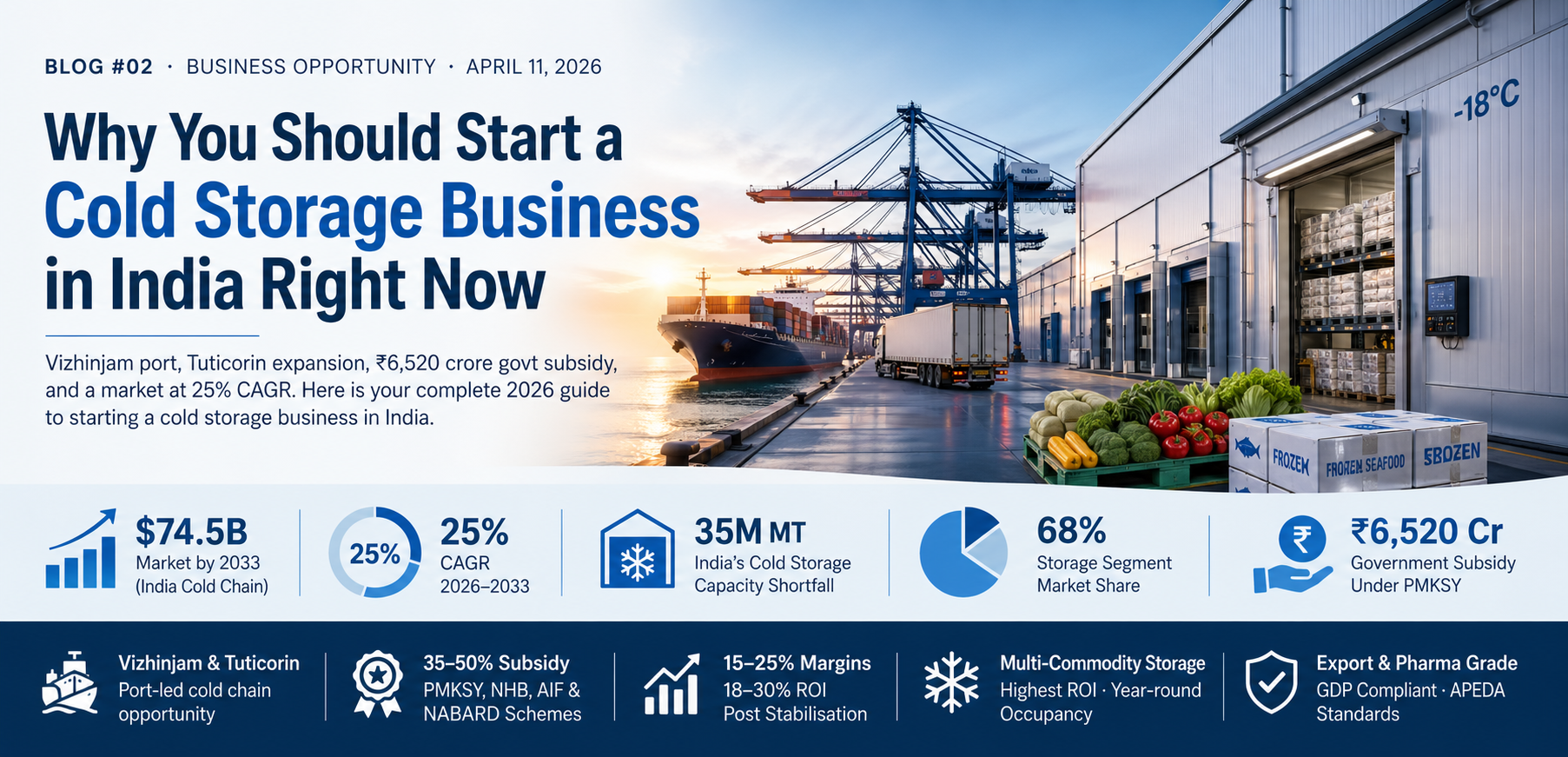
April 11, 2026 · 9 min read · Business Opportunity · Cold Chain
Cold storage business in India is no longer a back-room infrastructure play. It is one of the most compelling, government-backed, market-timed business opportunities in 2026 — and most people still haven’t noticed.
Two new deep-water ports are reshaping South India’s logistics map. A ₹6,520 crore government subsidy programme is actively funding cold chain projects. A market growing at 25% CAGR is screaming for capacity. An infrastructure gap of 30–35 million metric tonnes sits wide open, waiting to be filled.
If you have ever considered starting a cold storage business in India — 2026 is the year every signal is pointing in the same direction. Here is everything you need to know.
Cold Storage Business in India: The Scale of the Opportunity
The India cold chain market generated revenue of approximately $12.7 billion in 2025 and is projected to reach $74.5 billion by 2033 — a 25% CAGR that outpaces most sectors in the Indian economy. Cold chain storage commands a dominant 62–68% share of total market revenue.
A market nearly sextupling in size in eight years. Government tailwind. Consumer demand. Export ambition. And a structural capacity shortage compressing into the same entry window.
| $74.5B
Market by 2033 |
25%
CAGR 2026–2033 |
35M MT
Capacity Shortfall |
68%
Storage Market Share |
The structural reality: over 70% of India’s existing cold storage is concentrated in just five states — Uttar Pradesh, Punjab, Gujarat, Maharashtra, and West Bengal. The entire south and northeast of India is severely underserved. This is not a problem. It is a location opportunity.
| Market Insight
The NCCD estimates India’s cold storage shortfall at 35 million metric tonnes right now. Most existing facilities store only potato — a single commodity. Multi-product cold storage is chronically undersupplied across most of India. That is the gap entrepreneurs are being invited to fill — with government subsidy. |
The Vizhinjam Port Effect: Why South India’s Cold Chain Window Is Open Now
On May 2, 2025, PM Modi inaugurated the Vizhinjam International Deepwater Multipurpose Seaport in Kerala — India’s first dedicated deep-water container transshipment port. For cold chain entrepreneurs in South India, this is a market-defining event.
What Makes Vizhinjam a Cold Chain Game Changer
Vizhinjam sits just 10 nautical miles from the world’s busiest east-west shipping corridor connecting Europe to the Persian Gulf, Southeast Asia, and the Far East. With a natural depth of 24 metres, it docks Ultra-Large Container Vessels carrying over 24,000 TEUs without dredging — a competitive advantage no other Indian port has.
The world’s largest container ship — MSC Irina (24,346 TEUs) — made its maiden South Asian call at Vizhinjam in June 2025. The port is already on MSC’s Jade Service Route, directly connecting India to Europe, China, South Korea, and Singapore.
| ₹8,867 Cr
Project Investment |
24m
Natural Port Depth |
1M TEU
Phase 1 Capacity |
3M TEU
Capacity by 2028 |
Before Vizhinjam, 75% of India’s container transshipment went through Colombo, Singapore, and Jebel Ali — costing India $200–220 million annually. Now that transshipment is being reclaimed, the surrounding supply chain — warehousing, cold storage, refrigerated logistics, distribution — needs to be built. Fast.
The Kerala government has announced the Vizhinjam–Navaikkulam Growth Corridor modelled on Shenzhen — including agro and food processing hubs in Kilimanoor and Kallambalam — directly adjacent to where cold chain demand will explode.
| Port Opportunity Signal
Vizhinjam is expected to reduce logistics costs by up to 30% for South Indian exporters. Seafood, agri produce, processed food, and pharma — all temperature-sensitive — will now flow through this port at scale. The cold storage infrastructure to support this trade does not yet exist at required scale. This is the opportunity. |
V.O. Chidambaranar Port Tuticorin: Tamil Nadu’s Cold Chain Gateway
While Vizhinjam gets the headlines, V.O. Chidambaranar Port — Tuticorin — is quietly becoming one of South India’s most important cold chain logistics nodes. India’s second-largest port in Tamil Nadu, it handles approximately 7% of India’s container traffic and processed 29.70 million tonnes in FY2024–25 — a 6.74% increase in TEUs year-on-year.
Key 2025–26 Developments at Tuticorin
- Tuticorin International Container Terminal (TICT) operational since September 2024 — ₹434 crore investment, 600,000 TEU annual capacity, three Rail Mounted Quay Cranes with 58-metre outreach.
- North Cargo Berth-III dredged to 14.20m — handles vessels up to 10,000 TEUs; to be mechanised by December 2026 with 7 million tonnes per annum discharge capacity.
- March 2026: VOC Port arranged 90,000 sqm additional land for container storage — demonstrating strategic resilience as a South Indian logistics alternative during West Asia disruptions.
- Expected 9–10% YoY growth in container traffic. Direct container services to the US and Europe. Tamil Nadu’s industrial corridors as primary hinterland.
The Madurai–Tuticorin Industrial Corridor and the Chennai–Kanyakumari Industrial Corridor are channelling manufacturing investment into the region. Every manufacturing unit, agri exporter, and seafood processor along these corridors is a potential cold storage customer.
| South India Cold Chain Thesis
Vizhinjam in Kerala and Tuticorin in Tamil Nadu — two upgraded deep-water ports within the same South Indian logistics zone, both with international shipping lane access. Neither has adequate cold chain infrastructure at the required scale. This is the most compelling regional cold storage business case in India today. |
7 Reasons Why 2026 Is the Best Time to Start a Cold Storage Business in India
Market timing matters. In April 2026, at least seven converging forces are making this the most favourable entry window for cold storage entrepreneurs in India’s history.
1. The 35 Million Metric Tonne Gap
The World Bank and NCCD both identify India’s cold storage shortfall at 30–35 million metric tonnes. Over 50% of existing capacity is in two states. Multi-commodity cold storage — the format with the highest ROI and rental rates — is chronically undersupplied everywhere except Uttar Pradesh.
2. The Port-Led Export Surge
Vizhinjam and Tuticorin are triggering export growth in seafood, agri produce, processed food, and pharmaceuticals from South India. All of these export products require temperature-controlled storage. Port infrastructure is being built. Cold chain has not caught up yet.
3. Quick Commerce Creating Explosive Urban Demand
Blinkit, Zepto, and Swiggy Instamart are driving demand for small-format, last-mile cold storage near urban centres. India’s packaged food sales are projected to grow from $122.7 billion in FY2024 to $206.3 billion by FY2029, with frozen ready-to-eat meals growing at 18.1% annually. Every dark store needs a cold room.
4. Pharma Compliance Is Now Mandatory, Not Optional
The revised Schedule M of the Drugs and Cosmetics Rules had a CDSCO deadline of January 1, 2026. GDP-compliant cold storage is now a regulatory requirement for pharma manufacturers. This creates a large, captive demand pool for well-built pharma cold rooms — especially near pharma clusters in Bangalore, Hyderabad, and Chennai.
5. Government Subsidy at Historic High
In July 2025, the Union Cabinet approved ₹6,520 crore under PMKSY — the largest cold chain infrastructure allocation in India’s history — including ₹1,000 crore specifically for 50 multi-product food irradiation units. Subsidies cover 35–50% of eligible project costs. NABARD and NHB schemes provide interest subvention on top.
6. India-US Trade Deal Creating Export Pressure
The February 2026 India-US trade deal cut tariffs on Indian goods from 50% to 18%. Indian pharma and agri exporters now have meaningful US market access — but only if their supply chain delivers product at required quality and compliance standards. Cold chain is the critical link they are missing.
7. ROI Is Proven and Strong
A well-planned multi-commodity cold storage business delivers operating margins of 15–25% and ROI of 18–30% post-stabilisation. A 5,000 MT facility costs ₹3–4 crore. A 10,000 MT multi-commodity facility costs approximately ₹20 crore with a 6–7 year payback. With 35% government subsidy, effective capital outlay and payback period shrink significantly.
Government Support: Every Cold Storage Subsidy Scheme in 2026
India offers some of the most generous cold chain subsidies in the world. Here is every scheme available to cold storage entrepreneurs right now.
| Scheme | Key Benefits & Details |
| PMKSY-ICCVAI (MoFPI) | Up to ₹10 crore grant · 35% general / 50% difficult areas · FLI + Distribution Hub mandatory · Apply at sampada-mofpi.gov.in |
| NHB Capital Investment Subsidy | 35–50% credit-linked subsidy · For cold storage 5,000–20,000 MT capacity · Covers construction and modernisation |
| Agriculture Infrastructure Fund (AIF) | ₹1 lakh crore fund · 3% interest subvention · Collateral-free loans up to ₹2 crore · For FPOs, PACS, agri-startups |
| MIDH (Horticulture) | Financial assistance for pre-cooling, CA chambers, pack houses linked to horticulture |
| NABARD Cold Chain Financing | Dedicated cold chain lending · Lower interest rates · Repayment up to 10–12 years |
| State-Level Schemes | Punjab, Haryana, AP, Telangana, Maharashtra have additional incentives on top of central schemes |
| Subsidy Strategy
Combine PMKSY-ICCVAI grant (up to ₹10 crore) + AIF interest subvention (3%) + NABARD term loan for maximum financial leverage. Projects in NE states, J&K, Himachal, and ITDP areas qualify for 50% subsidy. Apply early through the SAMPADA portal — allocations are competitive and oversubscribed. |
What Type of Cold Storage Business Should You Start?
The type of cold storage facility you build determines your customers, revenue model, capital requirement, and ROI timeline. Here is the 2026 landscape.
| Type | Key Characteristics |
| Multi-Commodity Cold Storage | Highest ROI · Year-round occupancy · Multiple revenue streams · ₹8–25 crore · Recommended for most entrepreneurs |
| Export-Grade Cold Storage (Port-Side) | IQF · Blast freezing · APEDA registered · Best near Vizhinjam / Tuticorin · Seafood and agri focus |
| Pharma-Grade Cold Room | GDP/GMP/Schedule M compliant · High rental premium · ₹5–12 crore · Near pharma clusters |
| Urban Micro Cold Hub | ₹50L–₹2 crore · Quick commerce demand · Fast payback · High Tier 1 / Tier 2 city demand |
| Controlled Atmosphere (CA) Storage | Premium segment · High-value fruits · Extends shelf life 8–10x · ₹15–30 crore |
| Single-Commodity (Potato / Agri) | Seasonal revenue · Oversupplied in north India · Not recommended for South India |
Cold Storage Business Investment & ROI: Real Numbers
| Scale / Capacity | Estimated Project Cost | Best Use Case |
| Small Modular Cold Room (10–50 MT) | ₹15L – ₹80L | Urban micro hub · Quick commerce |
| Small Cold Storage (500–1,000 MT) | ₹80L – ₹2 Crore | Village-level · Single commodity |
| Medium Facility (5,000 MT) | ₹3 Crore – ₹5 Crore | Multi-product · FPO / cooperative |
| Large Facility (10,000 MT) | ₹15 Crore – ₹25 Crore | Commercial · Export-grade · Pharma |
| Integrated Cold Chain Hub | ₹25 Crore – ₹60 Crore+ | Processing + storage + reefer |
Net operating margins for well-run multi-commodity cold storage in India: 15–25%. ROI post-stabilisation (Year 3 onwards): 18–30%. With 35% government subsidy on a ₹5 crore project, effective outlay drops to ₹3.25 crore — and ROI improves proportionally.
| ROI Accelerator
Premium insulation (PUF panels) delivers ROI within 3–4 years through energy bill reduction — then pure savings for decades. Rooftop solar cuts grid dependency by 30%. Energy is 30–40% of operating cost. Every efficiency point goes directly to profit. Smart IoT monitoring reduces maintenance costs and extends equipment life. |
Why Partner with Nerastech for Your Cold Storage Project
The cold storage infrastructure has to work — reliably, efficiently, and in compliance with the regulatory standards that customers, export markets, and government subsidy programmes now demand. Nerastech has been engineering cold storage and refrigeration infrastructure since 2015, delivering turnkey solutions across 9+ industries in India.
- Turnkey cold storage projects — end-to-end from design and engineering through installation, commissioning, and handover. One point of accountability, zero gaps.
- AI-driven IoT refrigeration — real-time temperature monitoring, predictive failure alerts, remote dashboard. Your cold storage works smart, not just cold.
- GDP-compliant pharma cold rooms — WHO, GMP, and CDSCO Schedule M compliant with full continuous data logging.
- Export-grade cold storage — IQF, blast freezing, controlled atmosphere — built to APEDA compliance and international buyer requirements.
- BMS and HVAC integration — up to 30% energy savings through smart building controls and automated climate management.
- Plant revamping — upgrade existing cold rooms with IoT controls and energy-efficient refrigeration at 40% of new build cost.
- Subsidy project support — Nerastech builds facilities to the technical specifications required for PMKSY and NHB subsidy approval.
Who Should Start a Cold Storage Business in India Right Now?
This opportunity is not only for large corporates. The 2026 window — through government schemes, port-led demand, and market fragmentation — is specifically structured to benefit a wide range of entrepreneurs and investors.
- Agri entrepreneurs, FPOs, and farmer cooperatives near Vizhinjam, Tuticorin, and port regions — add value to produce before export.
- Food processing businesses needing temperature-controlled storage as part of a vertically integrated supply chain.
- Pharma manufacturers and distributors needing GDP-compliant cold rooms for Schedule M regulatory compliance.
- Real estate and warehouse investors seeking a high-yield, recession-resistant asset class with government subsidy backing.
- Logistics and transport companies expanding into cold chain as a higher-margin service line.
- Seafood exporters and marine processing units in Kerala, Tamil Nadu, and Andhra Pradesh building export-grade cold chain near new port infrastructure.
- Quick commerce and e-grocery operators needing micro cold hubs near urban consumption centres.
The Bottom Line: Start Now or Pay More Later
Cold storage business in India in 2026 sits at the intersection of every macro trend that matters — new port infrastructure at Vizhinjam and Tuticorin, trade deal-driven export growth, historic government subsidy, consumer behaviour shift toward fresh and frozen food, and pharma compliance pressure.
The market is growing at 25% CAGR. The capacity gap is 35 million metric tonnes. The subsidies are funded and live. The ports are open and moving cargo.
Entrepreneurs who move now build facilities at today’s land costs, claim today’s subsidy rates, and secure first-mover positioning in regions where demand will be exponential for the next decade. Wait, and you build against competition, at higher costs, into a market that has already priced in the opportunity.
| Ready to build your cold storage business with the right infrastructure partner?
Nerastech designs and delivers turnkey cold storage projects across India — from export-grade facilities near Vizhinjam and Tuticorin to pharma cold rooms, BMS integrated warehouses, and urban micro cold hubs. Talk to our engineering team today. info@nerastech.com · +91 8147359771 · nerastech.com |