

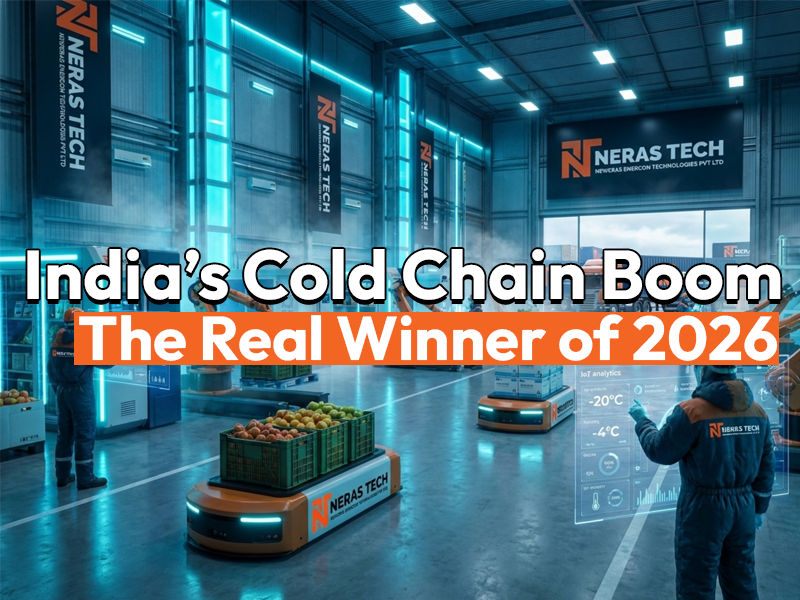
Why India’s Cold Chain Boom Is the Real Winner of the 2026 Trade Shift | Nerastech India cold chain 2026
April 9, 2026 · 6 min read · Industry Insights
India cold chain 2026 is not just a market trend — it is an infrastructure emergency triggered by trade opportunity, pharma growth, and a decade of accumulated demand that is finally converting into real investment.
The headlines in early 2026 were dominated by tariffs. First the US-India trade deal that slashed duties from 50% to 18%. Then the ripple effects — Indian exporters scrambling to scale, sectors recalibrating supply chains, and investors repositioning.
But while the world watched the trade negotiations, something quieter and more consequential was happening inside India’s infrastructure story. Cold storage — long underfunded and underbuilt — was suddenly at the centre of every serious conversation happening in pharma boardrooms, agri supply chains, and food processing plants.
This is that story. And it’s one that Nerastech has been building towards for over a decade.
India’s Cold Chain Gap: A Problem That Trade Growth Just Made Urgent
India is one of the world’s largest producers of perishable goods — fruits, vegetables, dairy, meat, seafood, and pharmaceuticals. Yet a significant portion of this production never reaches the end consumer in usable condition.
The World Bank estimates that India needs an additional 30 million tons of cold storage capacity just to meet current demand. Around 70–75% of existing cold storage infrastructure is concentrated in just five states — Uttar Pradesh, Punjab, Gujarat, Maharashtra, and West Bengal — leaving the rest of the country largely underserved.
| Market Stat
India’s cold chain logistics market is projected to grow from $23.28 billion in 2025 to $33.12 billion by 2031. Cold storage accounts for 68% of total market share. — Mordor Intelligence, 2026 |
This isn’t a new problem. What’s new is the pressure. India’s export ambitions — especially in pharma, agri, and processed food — now hinge on whether the cold chain infrastructure can match the opportunity.
How the 2026 Trade Shift Changed the Conversation
In February 2026, the India-US bilateral trade deal reduced reciprocal tariffs on Indian goods from 50% to 18%. For sectors like pharmaceuticals, food processing, agri exports, and industrial manufacturing, this was significant.
Lower tariffs mean more Indian goods are competitive in the US market. But competitiveness on paper means nothing without the operational infrastructure to back it up. And the infrastructure that ties everything together — cold storage — suddenly moved from a back-office cost to a front-line competitive advantage.
Three sectors where cold chain is now mission-critical:
- Pharmaceuticals
India exports over $8.7 billion in pharma goods to the US. The sector is shifting from small-molecule generics to biologics, vaccines, and biosimilars — products that are inherently temperature-sensitive and require GDP-compliant cold chain infrastructure. A single temperature excursion can invalidate an entire batch. With US market access now more viable, pharma companies need cold storage they can stake regulatory compliance on.
- Agriculture & Food Processing
India loses an estimated 40% of its fruits and vegetables annually to post-harvest spoilage — worth roughly ₹92,000 crore. Export ambitions in agri commodities are directly constrained by this infrastructure deficit. Smart cold storage that extends shelf life, monitors quality in real time, and connects farm to port is no longer optional — it’s the price of entry into global markets.
- Organised Retail & Quick Commerce
India’s e-commerce market is expected to reach $651 billion by 2034. Online grocery and quick commerce platforms are driving demand for last-mile cold storage near urban centres. Supermarkets, dark stores, and fulfilment hubs all require integrated, reliable cold chain infrastructure — and they need it at scale, fast.
What ‘Cold Chain 4.0’ Actually Means in Practice
The industry is increasingly using the phrase ‘Cold Chain 4.0’ — a reference to the integration of AI, IoT, automation, and renewable energy into cold storage operations. It sounds futuristic. In practice, it looks like this:
- Real-time temperature and humidity sensors that alert operators the moment a threshold is breached — not hours later when the damage is done.
- Predictive maintenance systems that flag equipment failure before it happens, reducing costly unplanned downtime.
- AI-driven energy optimisation that cuts power consumption by learning usage patterns and adjusting cooling cycles automatically.
- Remote dashboards that give facility managers full visibility and control from any device, anywhere.
- Solar integration for rural and off-grid cold storage, where power reliability is a persistent challenge.
This isn’t the future. This is the standard that global pharma, food, and agri companies are already demanding from their infrastructure partners in India — and what regulators like FSSAI and WHO-GDP frameworks are beginning to mandate.
| Key Insight
Cold storage infrastructure today is not just about keeping things cold. It is about data, compliance, energy efficiency, and supply chain intelligence — all running simultaneously. Companies that treat it as a utility will fall behind those that treat it as a competitive asset. |
Where the Investment Is Going — and Why Bangalore Is at the Centre of It
Cold chain storage currently dominates the Indian market with a 68% share, driven by extensive warehousing infrastructure development and growing demand across agricultural and pharmaceutical sectors.
Government programmes are accelerating this. The Union Cabinet approved ₹6,520 crore under PMKSY in 2025, including ₹1,000 crore specifically for food irradiation and cold chain expansion. The National Cold Chain Grid aims to connect farmers, processors, and retailers through a seamless temperature-controlled network.
Bangalore, as a hub for pharma manufacturing, biotech, and technology-driven supply chains, sits at the intersection of all these investment flows. Proximity to these industries — combined with access to engineering talent and technology infrastructure — makes it one of the most strategically significant locations for cold chain development in South India.
What This Means for Your Business Right Now
If you operate in any of the sectors below, the next 12–24 months are the window where infrastructure decisions will define competitive position for the decade ahead:
- Pharmaceutical manufacturers scaling US exports who need GDP-compliant cold storage with full data logging.
- Agri businesses and food processors looking to extend shelf life, reduce wastage, and enter organised retail or export markets.
- Commercial complexes, hotels, and retail chains that need reliable HVAC and BMS-integrated climate control.
- Manufacturing and industrial facilities where controlled environment storage is tied to product quality and compliance.
- Companies with ageing cold rooms running high energy bills who need a cost-effective revamp rather than a full rebuild.
In every one of these situations, the question is not whether to invest in cold chain infrastructure — it is how to do it right, with a partner who can deliver from design to commissioning, and support it with smart technology that keeps working long after handover.
How Nerastech Builds for This Moment
Since 2015, Nerastech — Neweras Enercon Technologies Pvt. Ltd. — has been delivering turnkey cold storage and smart refrigeration projects across more than nine industries in India.
The approach is not to sell a product. It is to engineer a solution — from feasibility and design through to installation, IoT integration, BMS commissioning, and long-term operational support.
What makes Nerastech’s approach different:
- AI-driven IoT monitoring with real-time alerts, predictive failure detection, and remote dashboard access.
- GDP and GMP-compliant pharmaceutical cold rooms with continuous data logging that meets WHO standards.
- Turnkey project delivery — one point of accountability from blueprint to below zero.
- Plant revamping services that upgrade legacy cold rooms without demolition, at 40% of new build cost.
- BMS and HVAC integration for commercial and industrial buildings that reduces energy consumption by up to 30%.
- Custom engineering across cold chain, food processing, aerospace, retail, hospitality, and agriculture.
The Bottom Line
India’s cold chain story in 2026 is not just a market trend report. It is a live infrastructure race, triggered by trade opportunity, regulatory pressure, and a decade of accumulated demand that is now converting into actual investment.
The businesses that move now — that build the right cold chain infrastructure, with the right technology, through the right partner — will not just meet the moment. They will own the next decade of India’s supply chain story.
| Ready to build cold chain infrastructure that’s built for this moment?
Nerastech designs and delivers turnkey cold storage, IoT refrigeration, BMS & HVAC, and plant revamp solutions across India. Talk to our engineering team — info@nerastech.com | +91 8147359771 | nerastech.com |